A political 4X in reverse: The Last Federation examined
Unlike Civilization, The Last Federation, by Arcen Games, makes you the last Hydral tasked with binding eight alien races. You act as an outside influencer, manipulating planetary economies, diplomacy, research, and warfare across a procedurally generated solar system while directing simultaneous turn-based tactical battles. The game pairs a political simulation of eight factions, a bullet-hell flavored combat layer, adjustable difficulty, and an observer mode. It suits grand strategy players who prefer diplomacy, political puzzles, and layered tactics over empire-building.
What kind of game is it?
The game reframes 4X expectations by asking you to influence rather than to rule, placing emphasis on subtle political work and targeted intervention. As the last Hydral you play an outside power who must balance eight distinct societies and their hatreds. Core player actions include:
- Influence planetary governments through bribery and blackmail,
- Manage economies and research direction indirectly,
- Intervene in wars using tactical engagements.
Does it have a multiplayer mode and how do mechanics interact?
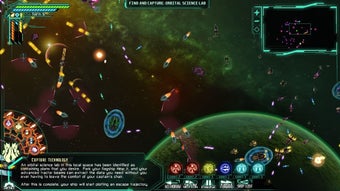
The title is a single-player simulation with an observer mode that lets you watch the system evolve without intervening. Its combat layer pairs simultaneous turn planning with short, real-time execution phases that carry bullet-hell visual energy, so each engagement asks for both tactical foresight and split-second observation. Difficulty controls let you change strategic and combat complexity independently, and the developer has shipped additional expansions to extend modes and options.
What does the game look and feel like in action?
Combat moments present dense projectile patterns and compact battlefields that create visual excitement during execution phases. Interface elements present many nested systems, and user reception repeatedly flags the UI and learning curve as challenging, which affects early impressions. The game runs on Mac systems with modest hardware requirements, making those action-heavy bursts accessible on typical desktop setups.
Is it hard to get started and why play again?
New players report a steep onboarding experience because multiple simulation layers require attention to political trends and economic levers simultaneously. The internal simulation produces a dynamic political landscape where nations rise and fall in response to your interventions, which gives campaigns distinct outcomes. Replay value comes from changing initial conditions and experimenting with different influence strategies, while the observer mode shows alternate histories without direct play.
In summary, a demanding political strategy best for patient tacticians
The game rewards players who enjoy digging into political systems and carefully staged tactical encounters, offering rich payoff for those who accept its learning curve. It is less suitable for someone seeking instant pick-up sessions because the interface and depth require investment. For strategists who want a persistent diplomatic puzzle and deliberate combat pacing, the game presents a distinctive and satisfying alternative to conventional empire-building titles.